Jump to navigation Jump to search




Education is the process of facilitating learning, or the acquisition of knowledge, skills, values, beliefs, and habits. Educational methods include story telling, discussion, teaching, training, and directed research. Education frequently takes place under the guidance of educators, however learners may also educate themselves.[1] Education can take place in formal or informal settings and any experience that has a formative effect on the way one thinks, feels, or acts may be considered educational. The methodology of teaching is called pedagogy.
Formal education is commonly divided formally into such stages as preschool or kindergarten, primary school,secondary school and then college, university, or apprenticeship.
A right to education has been recognized by some governments and the United Nations.[2] In most regions, education is compulsory up to a certain age. There is a movement for education reform, and in particular for the of evidence-based education.
Etymology
Etymologically, the word "education" is derived from the Latin word ēducātiō ("A breeding, a bringing up, a rearing") from ēducō ("I educate, I train") which is related to the homonym ēdūcō ("I lead forth, I take out; I raise up, I erect") from ē- ("from, out of") and dūcō ("I lead, I conduct").[3]
History
Education began in prehistory, as adults trained the young in the knowledge and skills deemed necessary in their society. In pre-literatesocieties, this was achieved orally and through imitation. Story-telling passed knowledge, values, and skills from one generation to the next. As cultures began to extend theirknowledge beyond skills that could be readily learned through imitation, formal education developed. Schools existed in Egypt at the time of the Middle Kingdom.[4]
Plato founded the Academy in Athens, the first institution of higher learning in Europe.[5] The city ofAlexandria in Egypt, established in 330 BCE, became the successor to Athens as the intellectual cradle ofAncient Greece. There, the great Library of Alexandria was built in the 3rd century BCE. European civilizations suffered a collapse of literacy and organization following the fall of Rome in CE 476.[6]
In China, Confucius (551–479 BCE), of the State of Lu, was the country's most influential ancient philosopher, whose educational outlook continues to influence the societies of China and neighbours like Korea, Japan, and Vietnam. Confucius gathered disciples and searched in vain for a ruler who would adopt his ideals for good governance, but his Analects were written down by followers and have continued to influence education in East Asia into the modern era.[7]
The Aztecs also had a well-developed theory about education, which has an equivalent word in Nahuatl called tlacahuapahualiztli. It means "the art of raising or educating a person"[8] or "the art of strengthening or bringing up men."[9] This was a broad conceptualization of education, which prescribed that it begins at home, supported by formal schooling, and reinforced by community living. Historians cite that formal education was mandatory for everyone regardless of social class and gender.[10] There was also the word neixtlamachiliztli, which is "the act of giving wisdom to the face."[9] These concepts underscore a complex set of educational practices, which was oriented towards communicating to the next generation the experience and intellectual heritage of the past for the purpose of individual development and his integration into the community.[9]
After the Fall of Rome, the Catholic Church became the sole preserver of literate scholarship in Western Europe.[11] The church established cathedral schools in the Early Middle Ages as centres of advanced education. Some of these establishments ultimately evolved into medieval universities and forebears of many of Europe's modern universities.[6] During the High Middle Ages, Chartres Cathedral operated the famous and influential Chartres Cathedral School. The medieval universities of Western Christendom were well-integrated across all of Western Europe, encouraged freedom of inquiry, and produced a great variety of fine scholars and natural philosophers, including Thomas Aquinas of the University of Naples, Robert Grosseteste of the University of Oxford, an early expositor of a systematic method of scientific experimentation,[12] and Saint Albert the Great, a pioneer of biological field research.[13] Founded in 1088, the University of Bologne is considered the first, and the oldest continually operating university.[14]
Elsewhere during the Middle Ages, Islamic science and mathematics flourished under the Islamic caliphatewhich was established across the Middle East, extending from the Iberian Peninsula in the west to the Indus in the east and to the Almoravid Dynasty and Mali Empire in the south.
The Renaissance in Europe ushered in a new age of scientific and intellectual inquiry and appreciation of ancient Greek and Roman civilizations. Around 1450, Johannes Gutenberg developed a printing press, which allowed works of literature to spread more quickly. The European Age of Empires saw European ideas of education in philosophy, religion, arts and sciences spread out across the globe. Missionaries and scholars also brought back new ideas from other civilizations – as with the Jesuit China missions who played a significant role in the transmission of knowledge, science, and culture between China and Europe, translating works from Europe like Euclid's Elements for Chinese scholars and the thoughts of Confucius for European audiences. The Enlightenment saw the emergence of a more secular educational outlook in Europe.
In most countries today, full-time education, whether at school or otherwise, is compulsory for all children up to a certain age. Due to this the proliferation of compulsory education, combined with population growth, UNESCO has calculated that in the next 30 years more people will receive formal education than in all of human history thus far.[15]
Formal education
Formal education occurs in a structured environment whose explicit purpose is teaching students. Usually, formal education takes place in a school environment with classrooms of multiple students learning together with a trained, certified teacher of the subject. Most school systems are designed around a set of values or ideals that govern all educational choices in that system. Such choices include curriculum, organizational models, design of the physical learning spaces (e.g. classrooms), student-teacher interactions, methods of assessment, class size, educational activities, and more.[16][17]
Preschool

Preschools provide education from ages approximately three to seven, depending on the country when children enter primary education. These are also known as nursery schools and as kindergarten, except in the US, where the term kindergarten refers to the earliest levels of primary education.[18] Kindergarten "provide[s] a child-centred, preschool curriculum for three- to seven-year-old children that aim[s] at unfolding the child's physical, intellectual, and moral nature with balanced emphasis on each of them."[19]
Primary

Taiwanese schoolchildren with their teacher standing on left, 2014
Primary (or elementary) education consists of the first five to seven years of formal, structured education. In general, primary education consists of six to eight years of schooling starting at the age of five or six, although this varies between, and sometimes within, countries. Globally, around 89% of children aged six to twelve are enrolled in primary education, and this proportion is rising.[20] Under the Education For All programs driven by UNESCO, most countries have committed to achieving universal enrollment in primary education by 2015, and in many countries, it is compulsory. The division between primary and secondary education is somewhat arbitrary, but it generally occurs at about eleven or twelve years of age. Some education systems have separate middle schools, with the transition to the final stage of secondary education taking place at around the age of fourteen. Schools that provide primary education, are mostly referred to as primary schools or elementary schools. Primary schools are often subdivided into infant schools and junior school.
In India, for example, compulsory education spans over twelve years, with eight years of elementary education, five years of primary schooling and three years of upper primary schooling. Various states in the republic of India provide 12 years of compulsory school education based on a national curriculum framework designed by the National Council of Educational Research and Training.
Secondary

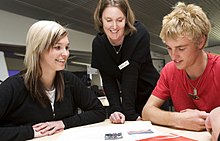
Students working with a teacher at Albany Senior High School, New Zealand
In most contemporary educational systems of the world, secondary education comprises the formal education that occurs during adolescence. It is characterized by transition from the typically compulsory, comprehensive primary education for minors, to the optional, selective tertiary, "postsecondary", or "higher" education (e.g. university, vocational school) for adults. Depending on the system, schools for this period, or a part of it, may be called secondary or high schools, gymnasiums, lyceums, middle schools, colleges, or vocational schools. The exact meaning of any of these terms varies from one system to another. The exact boundary between primary and secondary education also varies from country to country and even within them but is generally around the seventh to the tenth year of schooling.
Secondary education occurs mainly during the teenage years. In the United States, Canada, and Australia, primary and secondary education together are sometimes referred to as K-12 education, and in New Zealand Year 1–13 is used. The purpose of secondary education can be to give common knowledge, to prepare for higher education, or to train directly in a profession.
Secondary education in the United States did not emerge until 1910, with the rise of large corporations and advancing technology in factories, which required skilled workers. In order to meet this new job demand, high schools were created, with a curriculum focused on practical job skills that would better prepare students for white collar or skilled blue collar work. This proved beneficial for both employers and employees, since the improved human capital lowered costs for the employer, while skilled employees received higher wages.
Secondary education has a longer history in Europe, where grammar schools or academies date from as early as the 16th century, in the form of public schools, fee-paying schools, or charitable educational foundations, which themselves date even further back.
Community colleges offer another option at this transitional stage of education. They provide nonresidential junior college courses to people living in a particular area.
Tertiary (higher)

Students in a laboratory, Saint Petersburg State Polytechnical University
Higher education, also called tertiary, third stage, or postsecondary education, is the non-compulsory educational level that follows the completion of a school such as a high school or secondary school. Tertiary education is normally taken to include undergraduate and postgraduate education, as well as vocational education and training. Colleges and universities mainly provide tertiary education. Collectively, these are sometimes known as tertiary institutions. Individuals who complete tertiary education generally receive certificates, diplomas, or academic degrees.
Higher education typically involves work towards a degree-level or foundation degree qualification. In most developed countries, a high proportion of the population (up to 50%) now enter higher education at some time in their lives. Higher education is therefore very important to national economies, both as a significant industry in its own right and as a source of trained and educated personnel for the rest of the economy.
University education includes teaching, research, and social services activities, and it includes both the undergraduate level (sometimes referred to as tertiary education) and the graduate (or postgraduate) level (sometimes referred to as graduate school). Some universities are composed of several colleges.
One type of university education is a liberal arts education, which can be defined as a "college or universitycurriculum aimed at imparting broad general knowledge and developing general intellectual capacities, in contrast to a professional, vocational, or technical curriculum."[21] Although what is known today as liberal arts education began in Europe,[22] the term "liberal arts college" is more commonly associated with institutions in the United States such as Williams College or Barnard College.[23]
Vocational

Vocational education is a form of education focused on direct and practical training for a specific trade or craft. Vocational education may come in the form of an apprenticeship or internship as well as institutions teaching courses such as carpentry, agriculture, engineering, medicine, architectureand the arts.
Special
In the past, those who were disabled were often not eligible for public education. Children with disabilities were repeatedly denied an education by physicians or special tutors. These early physicians (people like Itard, Seguin, Howe, Gallaudet) set the foundation for special education today. They focused on individualized instruction and functional skills. In its early years, special education was only provided to people with severe disabilities, but more recently it has been opened to anyone who has experienced difficulty learning.[24]
Other educational forms
Alternative
While considered "alternative" today, most alternative systems have existed since ancient times. After the public school system was widely developed beginning in the 19th century, some parents found reasons to be discontented with the new system. Alternative education developed in part as a reaction to perceived limitations and failings of traditional education. A broad range of educational approaches emerged, including alternative schools, self learning, homeschooling, and unschooling. Example alternative schools include Montessori schools, Waldorf schools (or Steiner schools), Friends schools, Sands School, Summerhill School, Walden's Path, The Peepal Grove School, Sudbury Valley School, Krishnamurti schools, and open classroomschools. Charter schools are another example of alternative education, which have in the recent years grown in numbers in the US and gained greater importance in its public education system.[25][26]
In time, some ideas from these experiments and paradigm challenges may be adopted as the norm in education, just as Friedrich Fröbel's approach to early childhood education in 19th-century Germany has been incorporated into contemporary kindergarten classrooms. Other influential writers and thinkers have included the Swiss humanitarian Johann Heinrich Pestalozzi; the American transcendentalists Amos Bronson Alcott, Ralph Waldo Emerson, and Henry David Thoreau; the founders of progressive education, John Dewey and Francis Parker; and educational pioneers such as Maria Montessori and Rudolf Steiner, and more recently John Caldwell Holt, Paul Goodman, Frederick Mayer, George Dennison, and Ivan Illich.
Indigenous
Indigenous education refers to the inclusion of indigenous knowledge, models, methods, and content within formal and non-formal educational systems. Often in a post-colonial context, the growing recognition and use of indigenous education methods can be a response to the erosion and loss of indigenous knowledge and language through the processes of colonialism. Furthermore, it can enable indigenous communities to "reclaim and revalue their languages and cultures, and in so doing, improve the educational success of indigenous students."[27]
Informal learning
Informal learning is one of three forms of learning defined by the Organisation for Economic Co-operation and Development (OECD). Informal learning occurs in a variety of places, such as at home, work, and through daily interactions and shared relationships among members of society. For many learners, this includes language acquisition, cultural norms, and manners.
In informal learning, there is often a reference person, a peer or expert, to guide the learner. If learners have a personal interest in what they are informally being taught, learners tend to expand their existing knowledge and conceive new ideas about the topic being learned.[28] For example, a museum is traditionally considered an informal learning environment, as there is room for free choice, a diverse and potentially non-standardized range of topics, flexible structures, socially rich interaction, and no externally imposed assessments.[29]
While informal learning often takes place outside educational establishments and does not follow a specified curriculum, it can also occur within educational settings and even during formal learning situations. Educators can structure their lessons to directly utilize their students informal learning skills within the education setting.[28]
In the late 19th century, education through play began to be recognized as making an important contribution to child development.[30] In the early 20th century, the concept was broadened to include young adults but the emphasis was on physical activities.[31] L.P. Jacks, also an early proponent of lifelong learning, described education through recreation: "A master in the art of living draws no sharp distinction between his work and his play, his labour and his leisure, his mind and his body, his education and his recreation. He hardly knows which is which. He simply pursues his vision of excellence through whatever he is doing and leaves others to determine whether he is working or playing. To himself, he always seems to be doing both. Enough for him that he does it well."[32] Education through recreation is the opportunity to learn in a seamless fashion through all of life's activities.[33] The concept has been revived by the University of Western Ontario to teach anatomyto medical students.[33]
Self-directed learning
Autodidacticism (also autodidactism) is self-directed learning. One may become an autodidact at nearly any point in one's life. Notable autodidacts include Abraham Lincoln (U.S. president), Srinivasa Ramanujan(mathematician), Michael Faraday (chemist and physicist), Charles Darwin (naturalist), Thomas Alva Edison(inventor), Tadao Ando (architect), George Bernard Shaw (playwright), Frank Zappa (composer, recording engineer, film director), and Leonardo da Vinci (engineer, scientist, mathematician).
Evidence-based education
Evidence-based education is the use of well designed scientific studies to determine which education methods work best. It consists of evidence-based teaching and evidence-based learning. Evidence-based learningmethods such as spaced repetition can increase rate of learning.[34] The evidence-based education movement has its roots in the larger movement towards evidence-based-practices.
Open education and electronic technology
Many large university institutions are now starting to offer free or almost free full courses such as Harvard, MITand Berkeley teaming up to form edX. Other universities offering open education are prestigious private universities such as Stanford, Princeton, Duke, Johns Hopkins, the University of Pennylvania, and Caltech, as well as notable public universities including Tsinghua, Peking, Edinburgh, University of Michigan, and University of Virginia.
Open education has been called the biggest change in the way people learn since the printing press.[35]Despite favourable studies on effectiveness, many people may still desire to choose traditional campus education for social and cultural reasons.[36]
Many open universities are working to have the ability to offer students standardized testing and traditional degrees and credentials.[37]
The conventional merit-system degree is currently not as common in open education as it is in campus universities, although some open universities do already offer conventional degrees such as the Open University in the United Kingdom. Presently, many of the major open education sources offer their own form of certificate. Due to the popularity of open education, these new kind of academic certificates are gaining more respect and equal "academic value" to traditional degrees.[38]
Out of 182 colleges surveyed in 2009 nearly half said tuition for online courses was higher than for campus-based ones.[39]
A recent meta-analysis found that online and blended educational approaches had better outcomes than methods that used solely face-to-face interaction.[40]
Education sector
The education sector or education system is a group of institutions (ministries of education, local educational authorities, teacher training institutions, schools, universities, etc.) whose primary purpose is to provide education to children and young people in educational settings. It involves a wide range of people (curriculumdevelopers, inspectors, school principals, teachers, school nurses, students, etc.). These institutions can vary according to different contexts.[41]
Schools deliver education, with support from the rest of the education system through various elements such as education policies and guidelines – to which school policies can refer – curricula and learning materials, as well as pre- and in-service teacher training programmes. The school environment – both physical (infrastructures) and psychological (school climate) – is also guided by school policies that should ensure the well-being of students when they are in school.[41] The Organisation for Economic Co-operation and Development has found that schools tend to perform best when principals have full authority and responsibility for ensuring that students are proficient in core subjects upon graduation. They must also seek feedback from students for quality-assurance and improvement. Governments should limit themselves to monitoring student proficiency.[42]
The education sector is fully integrated into society, through interactions with a large number of stakeholders and other sectors. These include parents, local communities, religious leaders, NGOs, stakeholders involved in health, child protection, justice and law enforcement (police), media and political leadership.[41]
Several UN agencies have asserted that comprehensive sexuality education should be integrated into school curriculum.[43]
Development goals

Chimombo pointed out education's role as a policy instrument, capable of instilling social change and economic advancement in developing countries by giving communities the opportunity to take control of their destinies.[44]The 2030 Agenda for Sustainable Development, adopted by the United Nations (UN) General Assembly in September 2015, calls for a new vision to address the environmental, social and economic concerns facing the world today. The Agenda includes 17 Sustainable Development Goals (SDGs), including SDG 4 on education.[45][46]
Since 1909, the ratio of children in the developing world attending school has increased. Before then, a small minority of boys attended school. By the start of the 21st century, the majority of all children in most regions of the world attended school.
Universal Primary Education is one of the eight international Millennium Development Goals, towards which progress has been made in the past decade, though barriers still remain.[47] Securing charitable funding from prospective donors is one particularly persistent problem. Researchers at the Overseas Development Institutehave indicated that the main obstacles to funding for education include conflicting donor priorities, an immature aid architecture, and a lack of evidence and advocacy for the issue.[47] Additionally, Transparency International has identified corruption in the education sector as a major stumbling block to achieving Universal Primary Education in Africa.[48] Furthermore, demand in the developing world for improved educational access is not as high as foreigners have expected. Indigenous governments are reluctant to take on the ongoing costs involved. There is also economic pressure from some parents, who prefer their children to earn money in the short term rather than work towards the long-term benefits of education.
A study conducted by the UNESCO International Institute for Educational Planning indicates that stronger capacities in educational planning and management may have an important spill-over effect on the system as a whole.[49] Sustainable capacity development requires complex interventions at the institutional, organizational and individual levels that could be based on some foundational principles:[49]
- national leadership and ownership should be the touchstone of any intervention;
- strategies must be context relevant and context specific;
- plans should employ an integrated set of complementary interventions, though implementation may need to proceed in steps;
- partners should commit to a long-term investment in capacity development while working towards some short-term achievements;
- outside intervention should be conditional on an impact assessment of national capacities at various levels;
- a certain percentage of students should be removed for improvisation of academics (usually practiced in schools, after 10th grade).
Internationalization
Similarities – in systems or even in ideas – that schools share internationally have led to an increase in international student exchanges. The European Socrates-Erasmus Program[50] facilitates exchanges across European universities. The Soros Foundation[51] provides many opportunities for students from central Asia and eastern Europe. Programs such as the International Baccalaureate have contributed to the internationalization of education. The global campus online, led by American universities, allows free access to class materials and lecture files recorded during the actual classes.
The Programme for International Student Assessment and the International Association for the Evaluation of Educational Achievement objectively monitor and compare the proficiency of students from a wide range of different nations.
The internationalization of education is sometimes equated by critics with the westernization of education. These critics say that the internationalization of education leads to the erosion of local education systems and indigenous values and norms, which are replaced with Western systems and cultural and ideological values and orientation.[52]
Education and technology in developing countries

The OLPC laptop being introduced to children in Haiti
Technology plays an increasingly significant role in improving access to education for people living in impoverished areas and developing countries. However, lack of technological advancement is still causing barriers with regards to quality and access to education in developing countries.[53] Charities like One Laptop per Child are dedicated to providing infrastructures through which the disadvantaged may access educational materials.
The OLPC foundation, a group out of MIT Media Lab and supported by several major corporations, has a stated mission to develop a $100 laptopfor delivering educational software. The laptops were widely available as of 2008. They are sold at cost or given away based on donations.
In Africa, the New Partnership for Africa's Development (NEPAD) has launched an "e-school program" to provide all 600,000 primary and high schools with computer equipment, learning materials and internet accesswithin 10 years.[54] An International Development Agency project called nabuur.com,[55] started with the support of former American President Bill Clinton, uses the Internet to allow co-operation by individuals on issues of social development.
India is developing technologies that will bypass land-based telephone and Internet infrastructure to deliver distance learning directly to its students. In 2004, the Indian Space Research Organisation launched EDUSAT, a communications satellite providing access to educational materials that can reach more of the country's population at a greatly reduced cost.[56]
Private vs public funding in developing countries
Research into LCPS (low-cost private schools) found that over 5 years to July 2013, debate around LCPSs to achieving Education for All (EFA) objectives was polarized and finding growing coverage in international policy.[57] The polarization was due to disputes around whether the schools are affordable for the poor, reach disadvantaged groups, provide quality education, support or undermine equality, and are financially sustainable. The report examined the main challenges encountered by development organizations which support LCPSs.[57] Surveys suggest these types of schools are expanding across Africa and Asia. This success is attributed to excess demand. These surveys found concern for:
- Equity: This concern is widely found in the literature, suggesting the growth in low-cost private schooling may be exacerbating or perpetuating already existing inequalities in developing countries, between urban and rural populations, lower- and higher-income families, and between girls and boys. The report findings suggest that girls may be underrepresented and that LCPS are reaching low-income families in smaller numbers than higher-income families.
- Quality and educational outcomes: It is difficult to generalize about the quality of private schools. While most achieve better results than government counterparts, even after their social background is taken into account, some studies find the opposite. Quality in terms of levels of teacher absence, teaching activity, and pupil to teacher ratios in some countries are better in LCPSs than in government schools.
- Choice and affordability for the poor: Parents can choose private schools because of perceptions of better-quality teaching and facilities, and an English language instruction preference. Nevertheless, the concept of 'choice' does not apply in all contexts, or to all groups in society, partly because of limited affordability (which excludes most of the poorest) and other forms of exclusion, related to caste or social status.
- Cost-effectiveness and financial sustainability: There is evidence that private schools operate at low cost by keeping teacher salaries low, and their financial situation may be precarious where they are reliant on fees from low-income households.
The report showed some cases of successful voucher and subsidy programs; evaluations of international support to the sector are not widespread.[57] Addressing regulatory ineffectiveness is a key challenge. Emerging approaches stress the importance of understanding the political economy of the market for LCPS, specifically how relationships of power and accountability between users, government, and private providers can produce better education outcomes for the poor.
Educational theory

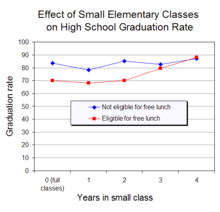
A class size experiment in the United States found that attending small classes for 3 or more years in the early grades increased high schoolgraduation rates of students from low income families.[58]
Educational psychology
Educational psychology is the study of how humans learn in educational settings, the effectiveness of educational interventions, the psychology of teaching, and the social psychology of schools as organizations. Although the terms "educational psychology" and "school psychology" are often used interchangeably, researchers and theorists are likely to be identified as educational psychologists, whereas practitioners in schools or school-related settings are identified as school psychologists. Educational psychology is concerned with the processes of educational attainment in the general population and in sub-populations such as giftedchildren and those with specific disabilities.
Educational psychology can in part be understood through its relationship with other disciplines. It is informed primarily by psychology, bearing a relationship to that discipline analogous to the relationship between medicine and biology. Educational psychology, in turn, informs a wide range of specialties within educational studies, including instructional design, educational technology, curriculum development, organizational learning, special education and classroom management. Educational psychology both draws from and contributes to cognitive science and the learning sciences. In universities, departments of educational psychology are usually housed within faculties of education, possibly accounting for the lack of representation of educational psychology content in introductory psychology textbooks (Lucas, Blazek, & Raley, 2006).
The intelligence–education relationship
Intelligence is an important factor in how the individual responds to education. Those who have higher intelligence tend to perform better at school and go on to higher levels of education.[59] This effect is also observable in the opposite direction, in that education increases measurable intelligence.[60] Studies have shown that while educational attainment is important in predicting intelligence in later life, intelligence at 53 is more closely correlated to intelligence at 8 years old than to educational attainment.[61]
মন্তব্যসমূহ
একটি মন্তব্য পোস্ট করুন